

























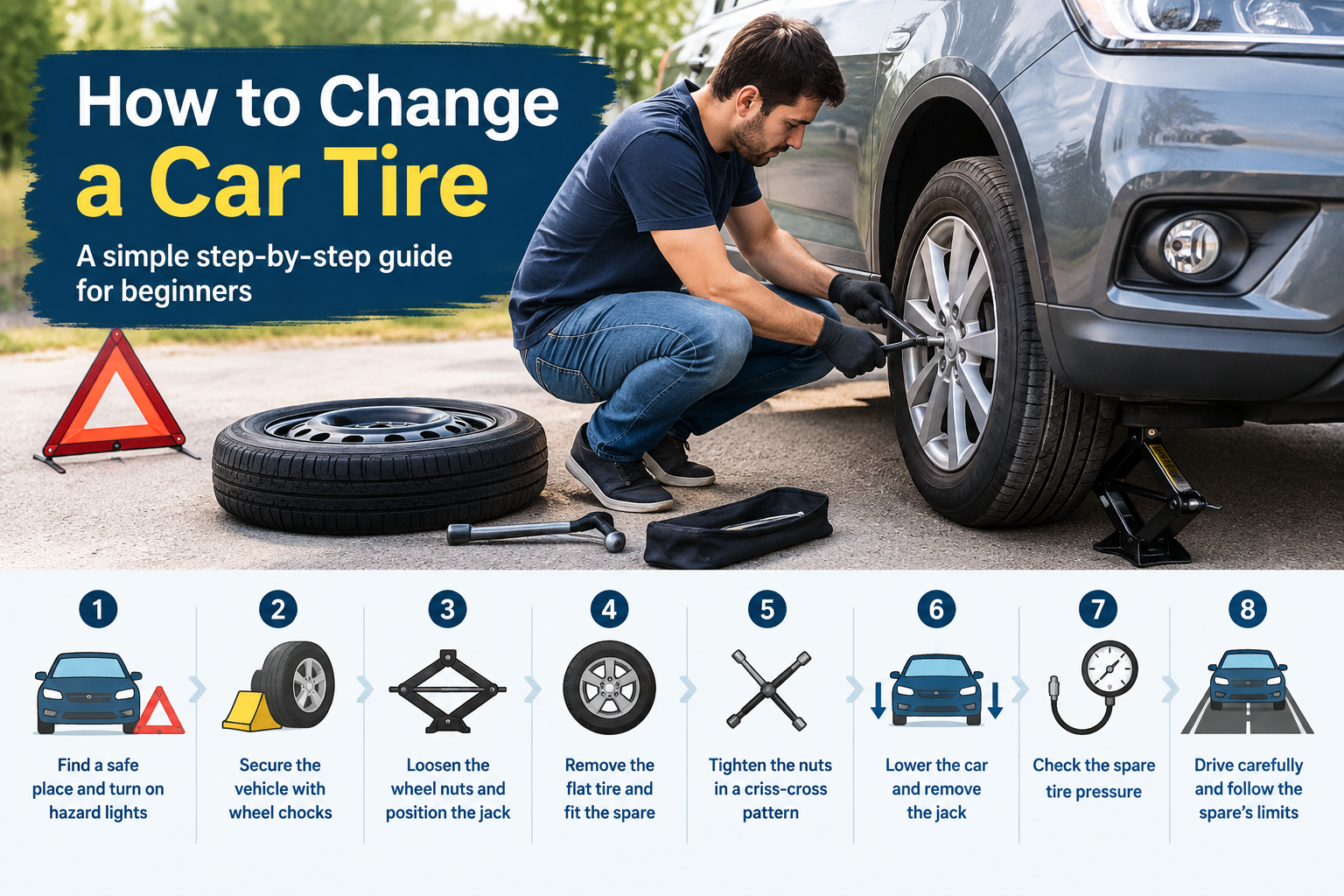
Quick Answer: How to Change a Car Tire
To change a car tire, park the car on a safe, level surface, turn on the hazard lights, apply the parking brake, and loosen the wheel nuts before lifting the vehicle. Position the jack at the manufacturer’s recommended lifting point and raise the car until the flat tire is off the ground. Remove the wheel nuts, take off the flat tire, fit the spare tire, hand-tighten the nuts, lower the car, and tighten the nuts securely in a criss-cross pattern. Finally, check the spare tire pressure and drive carefully according to the spare tire’s speed and distance limits.
A flat tyre can happen when you least expect it. You may be driving to work, heading out on a road trip, or simply returning home when you notice that your car is pulling to one side or a tyre has completely lost air. Knowing how to change a tyre can save you time and help you get back on the road without waiting for a mechanic.
Changing a tyre is not as difficult as it may seem. You mainly need the right tools, a safe place to work, and a little patience. However, safety should always come first. A car must be parked securely before you start lifting it, and the replacement tyre should be fitted correctly before you drive away. This guide explains how to change car tire step by step, from finding a safe location to checking the replacement tyre before continuing your journey.
What You Need Before Changing a Tyre
Before starting a car tire change, make sure you have the basic equipment. Most cars come with some of these tools, but it is worth checking them before you actually need them.
| Tool | Purpose |
| Spare tyre | Replaces the damaged or flat tyre |
| Car jack | Lifts the vehicle off the ground |
| Lug wrench | Loosens and tightens the wheel nuts |
| Wheel chocks | Prevent the car from moving |
| Gloves | Protect your hands from dirt and sharp edges |
| Flashlight | Useful when changing a tyre at night |
| Reflective warning triangle | Helps alert other drivers |
| Tyre pressure gauge | Checks the pressure of the spare tyre |
You may also want to keep a small torch, work gloves and a piece of cardboard or mat in your boot. These are not essential, but they can make the job easier.
When Should You Change a Tyre?
A tyre should be changed when it has a serious puncture, visible damage, or has lost too much air to continue driving safely. If your tyre is slowly losing air, do not assume that you can simply keep driving. Driving on a severely underinflated tyre can damage the tyre and wheel and may affect the car’s handling.
Look for signs such as:
- A completely flat tyre
- A visible puncture
- A damaged sidewall
- Excessive vibration
- The vehicle pulling to one side
- A tyre pressure warning light
- Unusual noise from one wheel
If the tyre has serious sidewall damage or the wheel itself appears damaged, replacing the tyre may not be enough. In that situation, it is safer to contact roadside assistance or a professional.
Step 1: Find a Safe Place to Stop
The first and most important part of how to change car tire is finding a safe place to work. If you notice a flat tyre while driving, reduce your speed gradually and move to a safe area. Avoid stopping on a narrow road, blind corner, soft shoulder or location where passing vehicles are too close.
Whenever possible:
- Move the car away from moving traffic.
- Park on firm and level ground.
- Turn on your hazard lights.
- Switch off the engine.
- Apply the parking brake.
- Put the car in Park if it has an automatic transmission.
- If it has a manual transmission, leave it in gear.
- Keep passengers away from traffic.
If you are on a busy highway and cannot reach a safe location, do not risk performing a roadside car tire change yourself. Contact roadside assistance instead.
Step 2: Secure the Vehicle
Once you have parked safely, make sure the vehicle cannot move. Use wheel chocks if you have them. Place them against the wheels opposite the one you are changing. For example, if you are changing a front tyre, the rear wheel can be secured. The exact placement can depend on the vehicle and the direction of the slope, so always follow the instructions in your vehicle owner’s manual. Never rely only on the jack to keep the vehicle from moving.
Step 3: Take Out the Spare Tyre and Tools
Open the boot and locate the spare tyre, jack and lug wrench. Some vehicles keep the spare tyre underneath the boot floor, while others mount it underneath the vehicle or do not provide a full-size spare at all.
Check the spare tyre before installing it. Look at the tread and sidewall for obvious damage. If possible, check its air pressure as well. This is an important part of learning how to change a tyre because a spare tyre that is damaged or badly underinflated may not be safe to use.
If your vehicle uses a temporary space-saver spare, remember that it may have different speed and distance limitations. Follow the instructions printed on the spare tyre and in the owner’s manual.
Step 4: Remove the Wheel Cover if Necessary
Some cars have a wheel cover or hubcap covering the wheel nuts. If your vehicle has one, carefully remove it using the tool supplied with the car or another suitable method recommended by the manufacturer. Do not force a cover with excessive pressure because it can crack or become damaged. Once the cover is removed, you should be able to see the wheel nuts.
Step 5: Loosen the Wheel Nuts
Before lifting the vehicle, loosen the wheel nuts slightly. Place the lug wrench securely over the first nut and turn it counterclockwise. You may need some force if the nuts are tight. Do not remove the nuts completely at this stage.
This step is easier while the tyre is still touching the ground because the weight of the car keeps the wheel from spinning. If a nut does not move, avoid jumping on the wrench or using excessive force. A damaged nut or wrench can make the rest of the car tire change much more difficult.
Step 6: Position the Jack Correctly
Finding the correct jack point is extremely important. Your vehicle has specific areas designed to support the weight of the car. These locations are usually described in the owner’s manual and may be marked on the vehicle.
Place the jack only at the recommended lifting point. Do not position the jack under random parts of the suspension, bodywork or floor. Using the wrong point can damage the vehicle or cause the jack to slip. Once the jack is correctly positioned, begin raising the vehicle slowly.
Step 7: Lift the Car
Raise the vehicle until the flat tyre is just clear of the ground. You generally do not need to lift the vehicle much higher than necessary. The tyre should have enough clearance to come off and allow the spare to be fitted. Keep your hands and feet away from underneath the vehicle while it is supported by the jack. Never place any part of your body underneath a car that is supported only by a standard emergency jack.
Step 8: Remove the Wheel Nuts
Now that the tyre is off the ground, completely remove the loosened wheel nuts. Keep them together somewhere safe so they do not roll away or become dirty. Hold the wheel with both hands and pull it straight toward you. Some wheels may be stuck because of rust or corrosion.
If the wheel does not come off easily, do not hit it aggressively or put yourself underneath the vehicle. Follow your vehicle manufacturer’s guidance or seek professional assistance.
Step 9: Install the Spare Tyre
Take the spare tyre and line up its holes with the wheel studs. Push the wheel onto the hub carefully. Once it is properly positioned, hand-tighten the wheel nuts. Do not fully tighten one nut while leaving the others loose. Tighten them gradually in a criss-cross or star pattern where applicable. This helps the wheel sit evenly against the hub. At this stage, the wheel should be secure enough to remain in place, but it is not yet ready for driving.
Step 10: Lower the Car Carefully
Use the jack to lower the car slowly until the tyre touches the ground. Do not lower it completely if you still need to perform the final tightening according to your vehicle’s instructions. Once the vehicle is stable, remove the jack and make sure the wheel is sitting correctly.
Step 11: Tighten the Wheel Nuts
Tighten the wheel nuts firmly using the lug wrench. Again, use a criss-cross or star pattern when recommended for your wheel design. If your vehicle manufacturer specifies a particular torque setting, use a torque wrench to achieve the correct value. Proper tightening is an important part of how to change a tyre safely.
Overtightening can damage the wheel studs or nuts, while insufficient tightening can allow the wheel to become loose. If you do not have a torque wrench, tighten the nuts firmly with the supplied wrench and have the wheel checked with a torque wrench at a tyre shop or service centre as soon as practical.
Step 12: Check the Spare Tyre
Before driving away, inspect the replacement tyre.
Check:
- Tyre pressure
- Wheel nuts
- Tyre condition
- Whether the tyre is sitting correctly
- Whether the jack and tools have been removed from the road
- Whether the damaged tyre is safely stored
If the spare tyre is a temporary space-saver, check its speed and distance restrictions. Do not treat a temporary spare as a permanent replacement. It is designed to help you reach a suitable repair or replacement location.
Step 13: Drive Carefully After the Change
Once the car tire change is complete, drive carefully. The spare tyre may handle differently from your normal tyre, especially if it is a different size or type. Avoid sudden acceleration, hard braking and sharp cornering.
If you feel vibration, hear unusual sounds, or notice that the vehicle is pulling to one side, stop somewhere safe and inspect the wheel. A temporary spare may also have a lower maximum speed than your regular tyres. Always follow the manufacturer’s instructions.
How to Change a Flat Tire on a Car: Quick Checklist
If you need a quick reminder of how to change a flat tire on a car, follow this basic sequence:
- Find a safe, level location.
- Turn on hazard lights.
- Apply the parking brake.
- Secure the vehicle with wheel chocks if available.
- Take out the spare tyre, jack and lug wrench.
- Loosen the wheel nuts slightly.
- Position the jack at the correct lifting point.
- Raise the car.
- Remove the wheel nuts.
- Take off the flat tyre.
- Fit the spare tyre.
- Hand-tighten the wheel nuts.
- Lower the car.
- Tighten the wheel nuts properly.
- Check the tyre pressure.
- Store the damaged tyre and tools.
- Drive carefully to a tyre shop or safe destination.
This sequence makes the process easier to remember when you are dealing with a flat tyre.
Common Mistakes to Avoid During a Tyre Change
Knowing how to change a tyre is useful, but knowing what not to do is equally important.
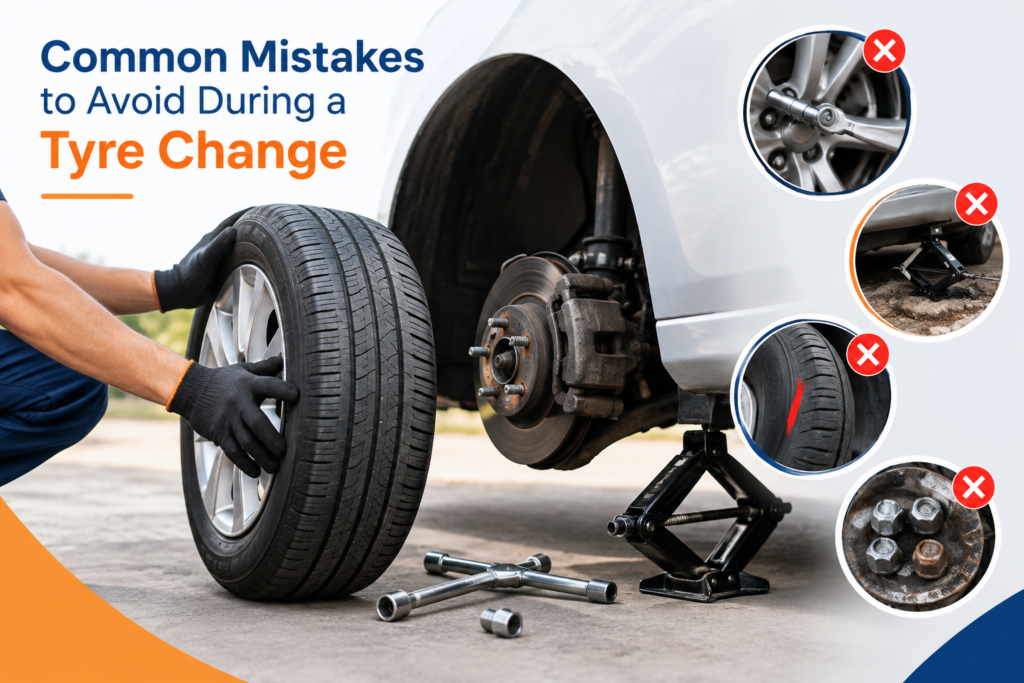
Changing the tyre on an unsafe surface
Never try to perform a roadside tyre change in a location where passing traffic creates a serious risk.
Using the wrong jack point
The jack should always be placed at the manufacturer’s recommended lifting point.
Removing the wheel nuts before loosening them
If the wheel is already off the ground, it can rotate while you try to loosen tight nuts. Loosening them slightly before lifting makes the job easier.
Getting underneath the vehicle
Never crawl underneath a car supported only by the emergency jack.
Forgetting to check the spare tyre
A spare that has been sitting unused for years may not have enough air pressure or may have deteriorated.
Driving too fast with a temporary spare
Space-saver tyres are not designed to behave like regular tyres. Follow the speed and distance restrictions provided by the manufacturer.
Not checking the wheel nuts
The job is not finished simply because the spare tyre is installed. Wheel nuts need to be tightened correctly.
Regular Tyre Checks Can Help Prevent Problems
You cannot prevent every puncture, but regular tyre maintenance can reduce the chance of unexpected problems. Check tyre pressure regularly, especially before long journeys. The recommended pressure is normally listed in the owner’s manual or on a vehicle information label. Inspect the tread for uneven wear, cracks, cuts or objects stuck in the tyre. It is also useful to check the spare tyre every few months. Many drivers remember their spare tyre only when they need it.
| Tyre Check | What to Look For | Recommended Action |
| Air pressure | Pressure below recommended level | Inflate to the manufacturer’s specification |
| Tread | Low or uneven tread | Have the tyre inspected or replaced |
| Sidewall | Cuts, cracks or bulges | Seek professional inspection |
| Puncture | Nail, screw or visible damage | Get the tyre professionally assessed |
| Spare tyre | Low pressure or damage | Inflate or replace as required |
| Wheel nuts | Loose or damaged nuts | Have them checked immediately |
When You Should Not Change the Tyre Yourself
Although how to change car tire is a useful skill, there are situations where professional help is the safer choice.
You should consider roadside assistance if:
- You are stopped in a dangerous traffic area.
- The car is on unstable or soft ground.
- The vehicle is on a steep slope.
- The jack or wheel tools are damaged.
- The wheel or hub appears damaged.
- You cannot safely position the jack.
- The spare tyre is missing or damaged.
- You are not confident that the wheel can be installed correctly.
- The weather makes roadside work unsafe.
There is no benefit in taking unnecessary risks just to avoid calling for help.
Can You Repair a Flat Tyre Instead of Replacing It?
Not every flat tyre needs to be replaced immediately. Some punctures in the tread area may be repairable, depending on their size, location and the condition of the tyre. Sidewall damage is generally a different matter and may require tyre replacement.
A temporary tyre plug or sealant may help in certain emergency situations, but these products should be used according to their instructions and vehicle manufacturer’s recommendations. A professional tyre technician can inspect the tyre and determine whether it can safely be repaired.
How Long Does a Tyre Change Take?
For someone who has never done it before, the process may take around 20 to 40 minutes under normal and safe conditions. An experienced driver may complete a basic car tire change more quickly.
However, speed should never be the main goal. Taking a few extra minutes to position the jack correctly, tighten the wheel nuts properly and check the spare tyre is far more important than finishing quickly. Roadside conditions can also make the process longer, particularly at night, in rain or in heavy traffic.
What to Do With the Flat Tyre
Once the spare is installed, place the damaged tyre in the boot or designated storage area if it fits. Do not simply leave the damaged tyre behind unless you are following a specific roadside service procedure. Take the tyre to a tyre shop for inspection. If the tyre can be repaired safely, a professional may be able to repair it. If it is damaged beyond repair, it will need to be replaced. If the tyre is only temporarily replaced with a space-saver spare, arrange a proper repair or replacement as soon as possible.
Why Learning How to Change a Tyre Is Useful
Knowing How to change a tyre is one of those basic driving skills that may not be needed often, but can be extremely useful when a problem occurs. You do not need to become a mechanic to learn the process. You simply need to understand where the vehicle should be lifted, how the wheel nuts work, how to install the spare and what safety precautions to follow.
It is also a good idea to read your vehicle owner’s manual before an emergency happens. Different vehicles have different jack points, spare tyre arrangements and wheel-nut specifications. Spending a few minutes learning the process at home can make an unexpected flat tyre much less stressful.
Final Safety Check Before Driving
Before leaving the location, take a moment to check everything. Make sure the wheel nuts are tightened, the tyre is properly seated, the spare has suitable pressure, and all tools have been removed from around the vehicle. Check your surroundings before pulling back onto the road.
If the spare tyre has specific speed or distance restrictions, follow them. Drive to a tyre professional if the damaged tyre needs repair or replacement. The most important part of learning how to change car tire is understanding that a successful tyre change is not just about removing one wheel and putting another one on. The vehicle must be secured, the wheel must be installed correctly, and the replacement tyre must be suitable for continued driving.
FAQs About Changing a Car Tyre
1. How to change a tyre for the first time?
Start by parking on a safe, level surface and applying the parking brake. Loosen the wheel nuts, position the jack correctly, raise the car, remove the damaged tyre and install the spare. Lower the car and tighten the wheel nuts properly before driving.
2. How to change a flat tire on a car safely?
Park away from traffic whenever possible, turn on the hazard lights, secure the vehicle and use the manufacturer’s recommended jack point. Never work underneath a vehicle supported only by a jack.
3. How long does a car tire change take?
A first-time tyre change may take around 20 to 40 minutes. The exact time depends on your experience, vehicle type, weather and roadside conditions.
4. Can I drive immediately after changing a tyre?
Yes, provided the replacement tyre is correctly installed and suitable for the vehicle. However, drive carefully and follow any speed or distance restrictions for a temporary spare.
5. Do I need to tighten the wheel nuts in a specific order?
Many wheels should be tightened using a criss-cross or star pattern so that the wheel sits evenly against the hub. Always follow the vehicle manufacturer’s instructions.
6. Can I change a tyre without a jack?
A normal wheel replacement generally requires the vehicle to be safely lifted. Do not attempt to improvise with unsafe objects. If the jack is missing or damaged, roadside assistance is a safer option.
7. How do I know if my spare tyre is safe?
Check the spare for visible damage and make sure its air pressure meets the manufacturer’s specification. Also check whether it is a temporary spare with specific speed and distance limitations.
8. Should I repair or replace a flat tyre?
It depends on the location and severity of the damage, along with the tyre’s overall condition. A tyre professional should inspect it before deciding whether repair is safe.
9. What should I do after a car tire change?
Check the wheel nuts, tyre pressure and overall condition of the replacement tyre. Store the damaged tyre and tools properly, then drive carefully to your destination or a tyre service centre.
10. What is the most important safety rule when changing a tyre?
Do not put yourself in danger to change a tyre. If you are stopped somewhere unsafe, such as a busy highway shoulder, contact roadside assistance instead of attempting the job yourself.