























Is your child scared of numbers? Or do they take too long to finish simple calculations that you would expect them to complete much faster? You are not alone. Many parents face this challenge every day and they are not sure if this can be solved by someone’s guidance or should they just wait to get fixed automatically as the child progresses in school. The good news is that there is a simple, fun-filled and time-tested tool that can help this problem in a guaranteed way: the Abacus.
Abacus for kids is one of the most popular ways to build strong math skills from an early age. But it actually does much more than teach addition and subtraction. It helps children think faster, focus better and feel more confident. In this blog, we will look at the key benefits of abacus, how it is taught and the skills your child can develop along the way.
What Is an Abacus?
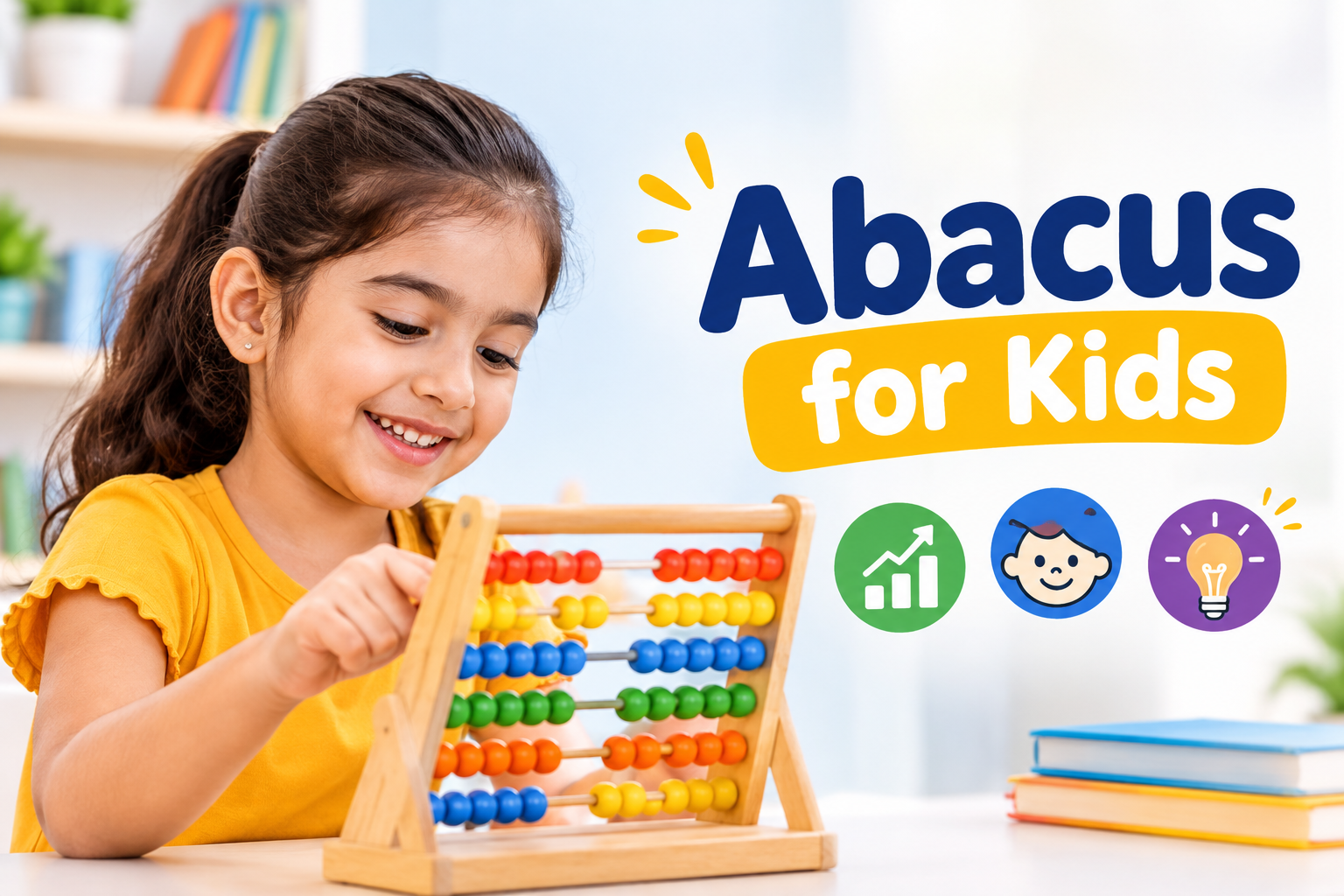
An abacus is a simple counting tool made of a frame (generally wooden or plastic based) with rods and beads. It has been used for thousands of years in countries like China and Japan. Today, the modern abacus is used in Abacus classes around the world to teach children mental math. During the Abacus training children move the beads to solve sums. Over time, they learn to picture the abacus in their mind and solve problems without the actual tool. This is called mental arithmetic, and this is where the real magic happens.
Top Benefits of Abacus for Kids
- Faster calculation speed: With regular abacus practice, kids can solve sums much faster. Many children who undergo advanced levels of Abacus training learn to add, subtract, multiply and divide big numbers in seconds, all in their heads (using the technique called ‘Visualization’, which is the core of Abacus secret.
- Better concentration and focus: Moving beads and tracking numbers needs full attention. This builds a habit of focus that helps kids in every subject and even in life challenges, not just math.
- Stronger memory: When children picture the abacus in their mind, they train their visual memory. This makes it easier to remember lessons, facts and instructions.
- Whole brain development: Abacus learning uses both hands and both sides of the brain. One side handles logic and numbers, while the other handles images and creativity. Using both together supports overall brain development in kids.
- More confidence: When math feels easy, children stop fearing it. They raise their hands in class, ask doubts without feeling shy, take part in quizzes and start to believe in their own abilities.
How Kids Learn Abacus: Simple Learning Methods
Good abacus training follows a step-by-step path. Here is how most programs work:
- Getting to know the tool: Kids first learn the parts of the abacus and how to move beads with their thumb and index finger.
- Basic counting: They learn what each bead and rod stands for and how to show numbers on the abacus.
- Simple sums with beads: Children start with easy addition and subtraction using the physical abacus.
- Visualization: Slowly, kids start to “see” the abacus in their mind and solve sums without touching it.
- Mental math practice: With daily practice, they move on to bigger numbers, multiplication, division and speed drills.
- Most abacus courses are divided into levels. Each level builds on the last one, so kids grow at a steady pace without feeling pushed. Online abacus classes have also made learning easier, as kids can practice from home with live teachers and fun activities.
Skills Your Child Develops Through Abacus
Abacus learning shapes skills that last a lifetime. Some of the key ones are:
• Problem-solving skills: Kids learn to break big problems into small, easy steps.
• Logical thinking: They begin to spot patterns and connections in numbers.
• Creativity and imagination: Picturing beads in the mind boosts visual thinking.
• Self-discipline: Regular practice teaches patience and good study habits.
• Speed and accuracy: Children learn to work fast without making careless mistakes.
What Is the Right Age to Start Abacus?
The best age to start abacus for kids is usually between 5 and 12 years. At this age, the brain is growing fast and picks up new skills easily. Younger kids can begin with basic levels, while older children often move ahead more quickly. Still, it is never too late to start. What matters most is regular practice and a good teacher. But if you have a choice, then remember that sooner the better. Since it is much easy to shape the mind and habits of kdis at a young age, they adapt much faster and retain much longer.
Quick Tips for Parents to choose Best Abacus Classes
Let me share some simple tips that if you apply carefully as a parent, you can surely find one of the best Abacus classes and ensure effective results in minimum imte.
- Choose a trusted abacus class with trained teachers and a structured course curriculum divided across 8-9 levels.
- Encourage 10 to 15 minutes of practice every day instead on relying on heavy practice just once a week (many children do this mistake unknowingly that this tremendously impacts the learning abilities negatively)
- Celebrate small wins to keep your child motivated
- Be patient, because real progress takes a few months.
Final Thoughts
Abacus is more than a Math tool. It is a fun way to help kids think faster, focus longer and feel proud of what they can do. The benefits of abacus go far beyond the classroom and support children in school, exams and daily life. If you want to give your child a strong start in math, now is the perfect time. Enroll your child at Mathcruise today. We provide one of the best Abacus online classes for kids (if not the best) and this is evident from Google reviews that are provided by our parent community. Join us and watch your kids grow into a confident, sharp and happy learner!