

























The Pearson Test of English (PTE) is one of the world’s most trusted English language proficiency tests for students, professionals, and migrants. If you’re wondering what is PTE, it is a computer-based English exam designed to assess your speaking, writing, reading, and listening skills using AI-powered scoring for fast and unbiased results. Accepted by thousands of universities, colleges, governments, and employers across the globe, the PTE exam has become a preferred choice for individuals planning to study abroad, apply for a visa, or pursue international career opportunities.
In this complete guide, you’ll learn everything about the PTE exam, including its different types, exam format, scoring system, eligibility, fees, and worldwide acceptance. Whether you’re preparing for higher education, immigration, or professional certification, this guide will help you understand how the PTE works and why it is one of the most widely recognised English proficiency tests today.
What is PTE (Pearson Test of English)?

If you’re planning to pursue higher education, build an international career, or relocate to another country, proving your English language proficiency is often a mandatory requirement. The Pearson Test of English (PTE) is one of the most trusted English proficiency exams that helps candidates demonstrate their communication skills in an academic and professional environment.
The PTE exam is conducted entirely on a computer and evaluates your speaking, writing, reading, and listening abilities through real-life, integrated question formats. Powered by advanced AI-based scoring, it provides consistent and unbiased assessment with results usually available within two days. Today, PTE scores are recognised by thousands of universities, visa authorities, and employers across the world, making it an excellent choice for students, skilled professionals, and immigration applicants seeking global opportunities.
Why Should You Take the PTE Exam?
The PTE Academic exam is one of the most preferred English language proficiency tests for students, professionals, and immigration applicants. Its AI-powered assessment, quick score reporting, and global recognition make it a reliable choice for anyone planning to study, work, or settle abroad.
Key Benefits of Taking the PTE Exam
- Receive Results Quickly: Get your PTE scores in as little as 48 hours, helping you meet university admission and visa application deadlines without unnecessary delays.
- Accepted Across the Globe: PTE scores are recognised by thousands of universities, colleges, employers, and government agencies in major study and immigration destinations.
- AI-Based Fair Scoring: The exam uses advanced automated scoring technology to ensure every candidate is assessed consistently and without examiner bias.
- Flexible Test Availability: With frequent test dates and numerous authorised test centres worldwide, you can choose a schedule that best fits your plans.
- Real-Life English Assessment: The exam measures speaking, writing, reading, and listening through integrated tasks that reflect practical communication in academic and professional settings.
- Fully Computer-Based Experience: From registration to testing, the entire process is digital, providing a modern and efficient exam experience.

Who Is the PTE Exam For?
The PTE exam is designed for individuals who need to prove their English language proficiency for international education, employment, or migration. It is suitable for a wide range of candidates, including:
- Students applying to universities and colleges abroad.
- Working professionals seeking employment or career advancement in English-speaking countries.
- Visa and immigration applicants who need an approved English language test for residency or migration programs.
- Healthcare and other licensed professionals who must demonstrate English proficiency for registration in certain countries.
- Anyone looking for a fast, accurate, and globally recognised English test with flexible scheduling and quick results.
Whether your goal is to study overseas, secure an international job, or immigrate to another country, the PTE Academic exam offers a trusted and convenient way to showcase your English communication skills.
Types of PTE Exams
Pearson offers different PTE exam types to meet the needs of students, professionals, and individuals applying for UK visas. Choosing the right exam depends on whether your goal is higher education, employment, immigration, or family settlement. Below are the main types of PTE tests and their purposes.
1. PTE Academic
PTE Academic is the most popular and widely accepted English language proficiency test for international students and professionals. It is a fully computer-based exam that measures your speaking, writing, reading, and listening skills through integrated question formats that reflect real-life academic and workplace communication.
The test is commonly taken by candidates applying to universities, colleges, employers, and immigration authorities in countries such as Australia, New Zealand, the UK, Canada, and many other destinations. With AI-powered scoring and quick results, PTE Academic has become one of the preferred English tests for studying and working abroad.
2. PTE Academic UKVI
PTE Academic UKVI is a Secure English Language Test (SELT) approved by the UK Home Office for specific UK visa and immigration applications. It is intended for candidates who need to prove their English proficiency when applying for eligible UK study, work, or visa routes.
The exam structure, question types, and scoring are almost identical to the standard PTE Academic test. However, the UKVI version includes additional identity verification procedures and provides a Unique Reference Number (URN) required during the UK visa application process.
3. PTE Home (A1, A2 & B1)
PTE Home is designed exclusively for UK family, settlement, and citizenship-related visa applications. Unlike PTE Academic, this test focuses only on speaking and listening skills, as these are the language abilities required for everyday communication in the UK.
PTE Home is available at three CEFR levels:
- PTE Home A1 – Suitable for initial family or partner visa applications.
- PTE Home A2 – Generally required when extending certain family visas.
- PTE Home B1 – Used for indefinite leave to remain (ILR) and British citizenship applications.
Instead of receiving a numerical score, candidates receive a Pass or Fail result based on whether they meet the required English language standard for their visa category.
Which PTE Exam Should You Choose?
The right PTE exam type depends on your purpose:
- Choose PTE Academic if you want to study abroad, apply for professional registration, or support immigration applications in many countries.
- Choose PTE Academic UKVI if your UK visa category specifically requires a SELT-approved English language test.
- Choose PTE Home (A1, A2, or B1) if you’re applying for UK family, settlement, or citizenship visas.
What Does the PTE Exam Include?
The PTE Academic exam is designed to assess your overall English language proficiency through three core sections: Speaking & Writing, Reading, and Listening. Instead of testing each skill separately, the exam uses integrated tasks that reflect real-life academic and professional communication. Here’s a detailed breakdown of each section.
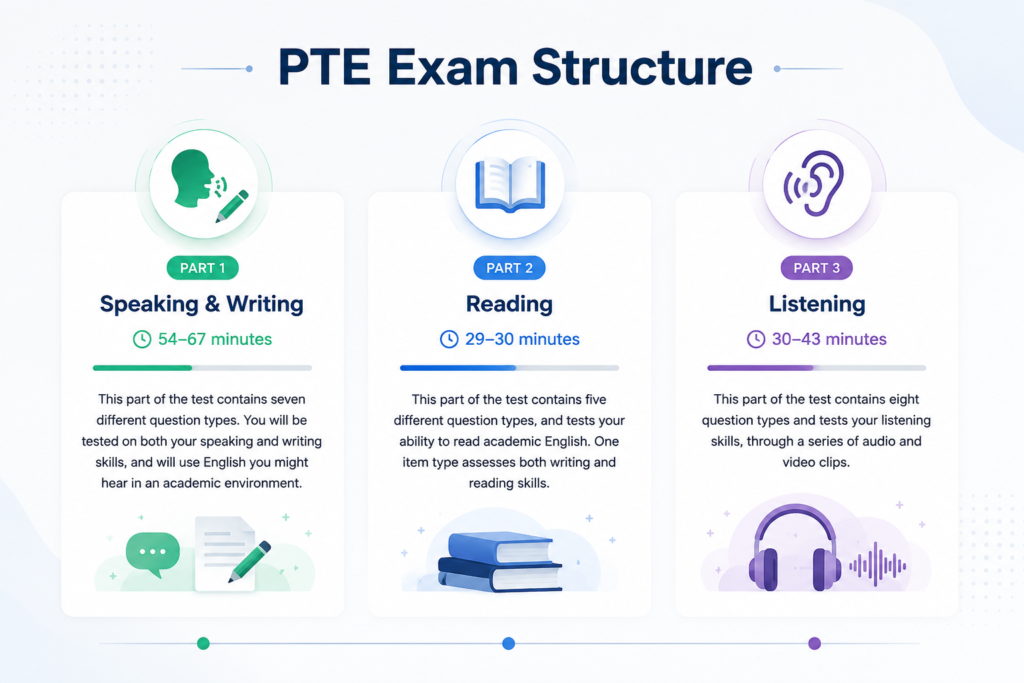
1. Speaking & Writing (54–67 Minutes)
The Speaking & Writing section is the first and most comprehensive part of the PTE exam, lasting approximately 54 to 67 minutes. It evaluates how effectively you can communicate in English through both spoken and written responses.
During this section, you’ll complete a variety of task types, including:
- Read Aloud
- Repeat Sentence
- Describe Image
- Re-tell Lecture
- Answer Short Question
- Summarise Written Text
- Write Essay
These tasks measure your pronunciation, oral fluency, grammar, vocabulary, spelling, and written communication skills. Since the exam is AI-scored, every response is evaluated consistently and objectively.
2. Reading (29–30 Minutes)
The Reading section measures your ability to understand and interpret written English commonly found in academic settings. It typically takes 29 to 30 minutes to complete and focuses on your comprehension, vocabulary, and grammatical accuracy.
You’ll encounter different question formats, such as:
- Reading & Writing: Fill in the Blanks
- Multiple Choice (Single Answer)
- Multiple Choice (Multiple Answers)
- Re-order Paragraphs
- Reading: Fill in the Blanks
This section assesses how well you can identify key ideas, understand sentence structure, and organise information logically.
3. Listening (30–43 Minutes)
The Listening section lasts around 30 to 43 minutes and evaluates your ability to understand spoken English across academic and everyday situations. You’ll listen to a variety of recordings, including lectures, interviews, discussions, and conversations, before answering related questions.
Common task types include:
- Summarise Spoken Text
- Multiple Choice (Single & Multiple Answers)
- Fill in the Blanks
- Highlight Correct Summary
- Select Missing Word
- Highlight Incorrect Words
- Write from Dictation
This section tests your ability to identify important information, understand different English accents, follow complex discussions, and accurately interpret spoken content.
PTE Exam Section Overview
| Section | Duration | Skills Assessed |
|---|---|---|
| Speaking & Writing | 54–67 minutes | Speaking, pronunciation, grammar, vocabulary, writing |
| Reading | 29–30 minutes | Reading comprehension, vocabulary, sentence structure |
| Listening | 30–43 minutes | Listening comprehension, note-taking, interpretation, spelling |
Together, these three sections provide a complete assessment of your English language proficiency, ensuring that your PTE score accurately reflects the communication skills required for study abroad, work opportunities, and immigration applications.
How to register for the PTE exam & PTE Test fees
Booking the PTE exam is a simple online process that can be completed in just a few steps. To avoid last-minute issues, it is advisable to register early, especially during university admission and immigration seasons when test slots are in high demand.
Steps to Register for the PTE Exam
1.Create a Pearson PTE Account
Visit the official Pearson PTE website and sign up using a valid email address. Make sure your personal details exactly match the information on your passport, as it is the primary ID accepted on the exam day.
2. Select Your PTE Exam Type
Choose the exam that matches your purpose:
- PTE Academic
- PTE Academic UKVI
- PTE Home (A1, A2, or B1)
3. Choose a Test Centre and Date
Search for available test centres near your location and select a date and time that suits your schedule. Pearson offers multiple test sessions throughout the year in many countries.
4. Review Your Details
Carefully verify your personal information, exam type, test centre, and selected date before proceeding with the payment.
5. Pay the Exam Fee
Complete the online payment using the available payment methods. Once your booking is successful, you’ll receive a confirmation email containing your test appointment details.
Tips Before Booking
- Register your exam 2–4 weeks in advance to secure your preferred test date.
- Ensure your passport is valid and the name matches your registration details.
- Read the cancellation and rescheduling policies before making the payment.
- Keep a copy of your booking confirmation for future reference.
PTE Exam Fees
The PTE exam fee varies depending on your country, test type, and the local taxes applicable. The cost of PTE Academic, PTE Academic UKVI, and PTE Home may differ from one region to another, so it’s important to check the latest pricing before booking your exam.
For example:
- In several countries, the PTE Academic fee is approximately USD 185.
- In Australia, the standard fee is generally around AUD 475.
Please note that these prices may change over time and can vary by location.
Additional Charges You Should Know
- Late Booking Fee: Additional charges may apply if you book your test close to the exam date.
- Rescheduling Fee: Changing your test date after booking may involve an extra fee, depending on when the request is made.
- Cancellation Policy: Refund eligibility depends on how far in advance you cancel your booking.
Since PTE test fees are updated periodically, always verify the latest charges and policies on the official Pearson PTE website before completing your registration.
Pro Tip: Booking your PTE exam early not only helps you avoid late fees but also gives you access to a wider choice of test dates and centres, making your exam planning much easier.
How to Prepare for the PTE Exam
Preparing for the PTE exam requires a smart study plan, consistent practice, and a clear understanding of the test format. Since the exam evaluates your speaking, writing, reading, and listening skills in a computer-based environment, regular practice with authentic questions can significantly improve your performance and overall PTE score.
Follow these proven tips to prepare effectively for the PTE test.

1. Learn the PTE Exam Format
Start by understanding the structure of the PTE Academic exam, including its sections, question types, and scoring system. Knowing what to expect on test day will help you answer questions with greater confidence and reduce exam anxiety.
2. Practice with Official PTE Resources
Use official Pearson practice tests, sample questions, and mock exams to experience the actual exam environment. Full-length mock tests also help you become familiar with the computer-based format while tracking your progress.
3. Strengthen Your Weak Areas
After each practice test, analyse your performance and identify the skills that need improvement. Spend extra time improving areas such as:
- Speaking fluency and pronunciation
- Essay writing and grammar
- Reading speed and comprehension
- Listening accuracy and note-taking
Focusing on weaker sections can lead to a better overall score.
4. Improve Time Management
Every section of the PTE exam has a time limit, so learning how to manage your time is essential. Practice answering questions within the allotted time to avoid rushing or leaving questions unanswered during the actual test.
5. Build Your English Vocabulary and Grammar
A strong vocabulary and good grammar improve your performance across all sections of the exam. Read English newspapers, articles, and academic content regularly, and learn new words in context to strengthen your language skills.
6. Get Comfortable with the Computer-Based Test
Since the PTE exam is conducted entirely on a computer, it’s important to practise using a keyboard, headset, and microphone. Familiarity with the testing interface will help you stay focused on answering questions rather than navigating the system.
7. Take Mock Tests Regularly
Full-length mock exams simulate the real test experience and help you measure your readiness. They also improve your confidence, endurance, and ability to perform under timed conditions.
8. Consider Professional Coaching
If you need structured guidance, enrolling in a PTE coaching programme or studying with an experienced mentor can help you understand exam strategies, receive personalised feedback, and improve faster.
9. Stay Healthy Before Exam Day
Your preparation isn’t limited to studying. Make sure you:
- Get enough sleep before the exam.
- Eat a balanced meal on test day.
- Stay hydrated.
- Arrive at the test centre early to avoid unnecessary stress.
Final Preparation Tips for the PTE Exam
Success in the PTE exam comes from consistent practice rather than last-minute studying. Focus on improving all four language skills, take regular mock tests, review your mistakes, and build confidence through daily practice. With the right preparation strategy, you’ll be well-equipped to achieve the PTE score required for your university admission, work opportunity, or immigration application.
Conclusion
The PTE exam has become one of the most trusted English language proficiency tests for students, professionals, and immigration applicants worldwide. If you were wondering what is PTE, it is a modern, AI-powered English assessment that measures your speaking, writing, reading, and listening skills through a fair, computer-based testing system.
With its fast results, objective scoring, flexible test dates, and worldwide acceptance, the PTE Academic exam is an excellent choice for anyone planning to study abroad, pursue international career opportunities, or apply for visas in English-speaking countries. By understanding the different PTE exam types, scoring system, registration process, and preparation strategies, you can confidently choose the right test and maximise your chances of achieving your target score.
Whether your goal is higher education, overseas employment, or global migration, the PTE exam provides a reliable and widely recognised pathway to demonstrate your English language proficiency and take the next step towards your international ambitions.
Disclaimer: The information provided in this guide is for general informational purposes only. While every effort has been made to ensure the content is accurate and up to date, PTE exam policies, fees, eligibility criteria, test formats, and acceptance requirements may change over time. We recommend verifying the latest information through the official Pearson PTE website or consulting the relevant university, organisation, or immigration authority before making any decisions based on this content.
FAQ’s
What is the PTE exam?
The PTE (Pearson Test of English) is a computer-based English proficiency test that assesses speaking, writing, reading, and listening skills. It is accepted by universities, employers, and immigration authorities worldwide for study, work, and visa applications.
Who is eligible to take the PTE exam?
Anyone who wants to study abroad, work overseas, or apply for immigration can take the PTE exam. There is no official educational qualification required, but candidates must meet the age and eligibility requirements set by Pearson.
How is the PTE exam scored?
The PTE Academic exam is scored using AI technology on a scale of 10 to 90. The system evaluates all four language skills objectively and usually releases results within 48 hours.
Which countries accept PTE scores?
PTE scores are accepted in countries like Australia, the UK, Canada, New Zealand, the USA, and Ireland. Thousands of universities, employers, and government organisations recognise PTE for education, work, and immigration.
How long is the PTE score valid?
A PTE Academic score is generally valid for 2 years from the test date for study and work purposes. Some immigration authorities may have different validity rules, so always check the latest official requirements.